
EDUTAINMENT
Free Downloads
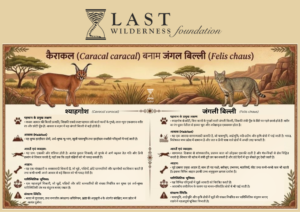
श्याहगोश बनाम जंगली बिल्ली (सामुदायिक जागरूकता)
श्याहगोश और जंगली बिल्ली (जंगल कैट) आकार और रूप में समान होने के कारण अक्सर एक-दूसरे से भ्रमित कर दी जाती हैं। हालांकि, ये दोनों अलग-अलग प्रजातियों की जंगली बिल्लियाँ हैं, जिनकी शारीरिक बनावट, आवास और व्यवहार में स्पष्ट अंतर होता है। मानव-प्रधान क्षेत्रों में पाई जाने वाली वन्यजीव प्रजातियों के बारे में सही जानकारी और जागरूकता बढ़ाने के लिए सही पहचान अत्यंत आवश्यक है।
यह पोस्टर श्याहगोश और जंगली बिल्ली के बीच मुख्य अंतर को सरल और आसानी से पहचाने जा सकने वाले लक्षणों के माध्यम से दर्शाता है। इसे शहरी और ग्रामीण दोनों क्षेत्रों के लिए एक जागरूकता एवं सीखने के साधन के रूप में तैयार किया गया है।
इस पोस्टर का उपयोग गैर-सरकारी संगठन (NGOs), वन विभाग के कर्मचारी, शिक्षक और स्वयंसेवक गाँवों, स्कूलों, प्रकृति शिक्षा केंद्रों और शहरी क्षेत्रों में प्रदर्शन हेतु कर सकते हैं, जिससे वन्यजीव शिक्षा को बढ़ावा मिले और मानव-वन्यजीव सहअस्तित्व को प्रोत्साहित किया जा सके।
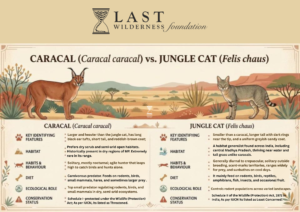
Caracal Vs Jungle Cat - Community Awareness
Caracals and Jungle Cats are often confused due to their similar size and appearance. However, they are two distinct wild cat species with different physical features, habitats, and behaviours. Correct identification is important for improving awareness and reducing misinformation about wildlife found in human-dominated landscapes.
This poster highlights the key differences between a Caracal and a Jungle Cat, helping viewers distinguish between the two through easily identifiable characteristics. It is designed as an awareness and learning tool for both urban and rural audiences.
The poster can be used by NGOs, Forest Department staff, educators, and volunteers for display in villages, schools, nature centres, and within city limits, to support wildlife education and informed coexistence.

Prevention of Snakebites (Hindi) - Community Awareness

Snakebite First Aid (Hindi) - Community Awareness
Snakes form an important part of our ecological system, keeping our rat population in check. However, there are times when they come in contact with people in the form of snake bites. There are many traditional practices that people in rural India follow even today. This poster aims to provide a standard protocol to be followed incase of a snakebite, the Do’s and Don’ts to be adhered to. And the best treatment is to get to the hospital immediately without wasting time to identifying the snake.
This poster can be used by all NGOs, Forest Department, volunteers etc. to be put up in villages near Tiger Reserves.

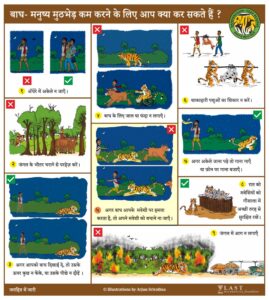
Prevention of Human-Tiger conflict (Hindi) - Community Awareness
People living in proximity to tiger reserves often come into contact with the big cat often resulting in conflict. Hence, in order to help reduce the same, LWF in association with Bandhavgarh Tiger Reserve management released a poster to be displayed in and around villages that will help in disseminating the Do’s and Dont’s of living with tigers, thereby ensuring the safety of the villagers and tigers alike.
This poster can be used by all NGOs, Forest Department, volunteers etc. to be put up in villages of Central India.
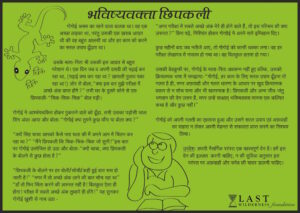
Stories

Artworks
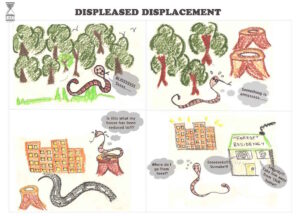
To this effect, Last Wilderness brings to you, a series of caricatures that outline how intentional, un-intentional human disturbance or interference has put our wildlife at risk,in the hope that we learn from our mistakes and attempt to accommodate, co-exist with those whose survival is as important as ours! Human- Wildlife interactions have usually bode ill for man and our wild denizens alike, which in turn, has resulted in the relationship between man and animal to deteriorate over the years.
Posters
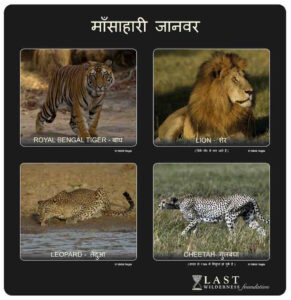
A visual depiction of India’s Herbivore’s & Carnivore’s, can be used as educational materials in posters or in presentations.
Purchases
Web of Life
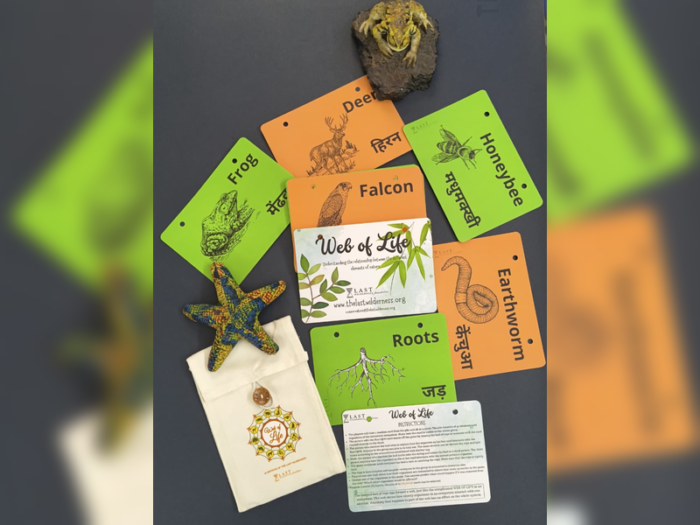
Web of Life is an interactive learning game that helps players explore how plants, animals, and humans are interconnected. Through a simple, participatory activity, players build a “web” that demonstrates how changes to one element of nature can affect many others.
Ideal for classrooms, workshops, and environmental education programmes, the game encourages systems thinking, collaboration, and discussion—making complex ecological ideas easy to grasp.
How to play
- Each player represents a species or natural element
- Players pass a string/connection to show relationships such as food, shelter, or dependence
- As the web forms, players observe how every element is linked
- When one element is disturbed or removed, the web reacts, showing real-world ecological impact
What’s included?
A complete Web of Life game kit, including role cards and connection material, packed in a durable, reusable pouch for easy storage and repeated use.
Bilingual: English & Hindi
Price: ₹550/- (Courier charges extra)
To order: Write to us at conservation@thelastwilderness.org
Wildlife Bingo
A classic bingo game with an Indian wildlife twist
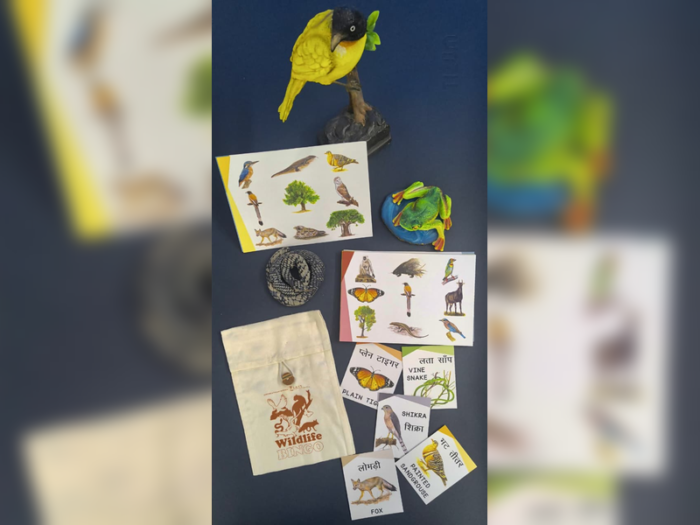
Wildlife Bingo brings the much-loved game of bingo into the world of wildlife. Instead of numbers, players match animals and birds found across India, making each round interactive, engaging, and easy to follow.
Well-suited for classrooms, workshops, nature clubs, and family play, the game encourages listening, quick recognition, and group participation—while naturally sparking conversations about wildlife.
How to play
- Each player receives a bingo card illustrated with wildlife species
- A caller randomly picks and announces a species card
- Players mark the matching species on their card
- The first player to complete a row (or full card, as agreed) calls out “Bingo!”
What’s included?
A complete Wildlife Bingo game set with illustrated bingo cards and calling cards, neatly packed in a durable, reusable pouch, perfect for repeated use in classrooms and learning sessions.
Bilingual: English & Hindi
Price: ₹600/- (Courier charges extra)
To order: Write to us at conservation@thelastwilderness.org
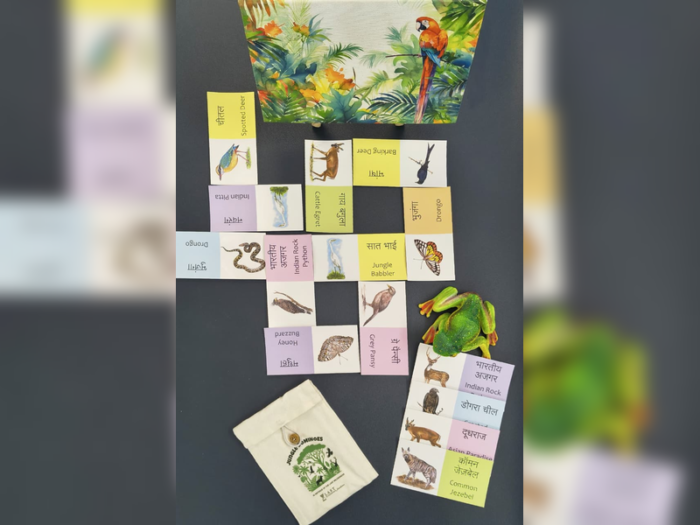
Jungle Dominoes
Jungle Dominoes is a wildlife-themed version of the classic dominoes game. Instead of numbers, players match animals and birds found across India, making the game intuitive, engaging, and easy to pick up for all age groups.
Well suited for classrooms, nature clubs, workshops, and family play, the game builds observation skills, pattern recognition, and encourages conversations about wildlife—without feeling instructional.
How to play
- Each player is dealt a set of wildlife domino cards
- Players take turns matching species illustrations instead of numbers
- The aim is to be the first to place all cards or make the longest valid chain
- Play follows familiar domino rules, making it quick to learn
What’s included?
A complete Jungle Dominoes card set with illustrated wildlife cards, packed in a sturdy, reusable pouch—easy to store and carry for learning anywhere.
Bilingual: English & Hindi
Price: ₹450/- (Courier charges extra)
To order: Write to us at conservation@thelastwilderness.org
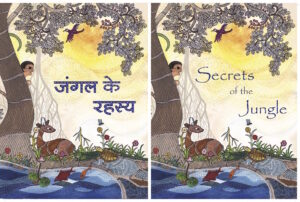
Secrets of the Jungle
In order to celebrate all things wild, Last Wilderness Foundation in association with Kalpavriksh brings to you ‘Secrets of the Jungle‘ or ‘Jungle Ke Rahasya‘ an activity book that provides a gamut of information about the Indian forests and the species living within. A treat especially for children, filled with activities that enhance knowledge about the wilderness in a fun way, the book can be enjoyed as a teacher’s handbook too.
Available in English & Hindi.
The book is priced at Rs. 150/- (Courier charges extra).
To order, contact us at conservation@thelastwilderness.org
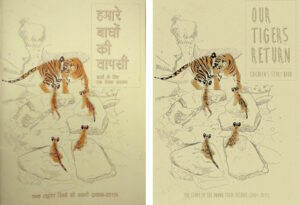
Our Tigers Return
The Story of Panna Tiger Reserve (2009 – 2015) is an illustrated children’s book, written in a narrative style with Megha, a village girl from Panna in conversation with Shri. R. Sreenivasa Murthy, Ex-Director of the Panna Tiger Reserve, authored by Peeyush Sekhsaria and published by LWF. It celebrates the uniqueness of Panna Tiger Reserve and narrates the magnificent story of the revival of Panna and its tigers.
Available in English & Hindi.
The book is priced at: Rs. 150/- (Hindi version); Rs. 200/- (English version); Courier charges extra.
To order, contact us at conservation@thelastwilderness.org
Videos
Pandemic & Pardhi, as a project started with a thought, “How are tribal communities surviving through this pandemic?” Supported by the National Geographic Society Emergency Grant, this thought evolved into a storytelling exploration project. LWF, an organisation working with tribes throughout central India became a bridge connecting the director and National Geographic Explorer, Ishan Sharma, to the Pardhis of Panna and Baigas of Kanha. The Pardhi community was infamous for its hunting traditions. But through intervention by the government and LWF, they have moved away from the jungle and practice alternative sources of livelihood. Pandemic & Pardhi, depicts the reality of tribes who live on the edges of forests and how the pandemic has impacted their livelihoods.
Walk with the Pardhis
‘Walk with the Pardhis’ an initiative undertaken by Last Wilderness Foundation in association with Taj Safaris and Management of Panna Tiger Reserve, is an alternative source of livelihood for the Pardhi community members, by channelizing the age old knowledge of the forest and the skills of identifying animal tracks and signs.
Story behind the Baiga Jewellery
Baigas are a forest dwelling tribe that live in the jungles on Central India. In order to reduce their dependency on the forest, an attempt has been made to introduce them to an alternate source of livelihood. Last Wilderness Foundation (LWF) works closely with the forest department and communities to reduce human-wildlife conflict near tiger reserves. In our work with this tribe, we’ve explored a sustainable source of living using an already existing skill set of the tribe – Jewellery Making.
Tiger Song - How to avoid human-tiger conflict (in Hindi)
People living in the buffer zones of Tiger Reserves co-exist with tigers. Sometimes there are conflict situations where human or tiger lives could be lost. This song is one way to spread awareness amongst these villagers on what precautionary measures can be taken to protect themselves in order to avoid any such conflicts. To help spread awareness and reduce man-animal conflicts, please feel free to screen this video at suitable locations.
Living with Tigers - A glimpse
In 2011 the LWF Team embarked on a journey to gain an insight into the lives of people who live in proximity to the tiger reserve and often alongside the tiger. This then is one such glimpse into the hardships they encounter, their dependency on the forest, conflict with the tiger, livelihood and the lives they lead as people of the forest.
Tigers in the backyard
Tigers and man have been existing together for many years, but the need for space and sharing of resources has led to a slight imbalance, thereby frequenting the conflict scenario between the two. However, the situation on ground is not all grim. Communication and interaction with the villagers has helped form an invisible bridge and a relatively visible communication channel between the Forest department and villagers. This initiative started by LWF 4 years ago has led to a smoother management of conflict situations in Bandhavgarh Tiger Reserve. Apart from conservation outreach, LWF also engages in training programmes for the Forest Department to help equip them with the necessary management skills.
BAGH : Humara Astitva = Saha-astitva
LWF team brings you a movie that takes you through today’s scenario of man-tiger co-existence (Hamara Astitva = Sah-astitva) by ‘Van Devi’ herself. All is not lost even now, she says. How can you help? Find out for yourself.The movie has been created for awareness and outreach purpose, especially for areas/villages surrounding our tiger reserves.
Beyond sightings - A vision of Kanha Tiger Reserve
Last Wilderness Foundation in association with the Forest Department, Kanha Tiger Reserve conducted a Nature Education Camp for 23 visually impaired students and their teachers from the Ananya Manav Seva Sai Samiti, Jabalpur in Jan 2017. A first time ever in the forest for these students, the idea was to help them connect with nature based purely on touch, calls and hearing. This video is an attempt to showcase a few glimpses of the time spent with the students.
Village Kids Awareness programme
The Village Kids’ Awareness Programme is conducted by LWF in the villages surrounding the tiger reserves. This programme helps the students to appreciate and understand the forest and the need to save them. Through this programme, each child starts relating their lives to the forest and it’s denizens, thus creating a larger and larger group of protectors through the years!