
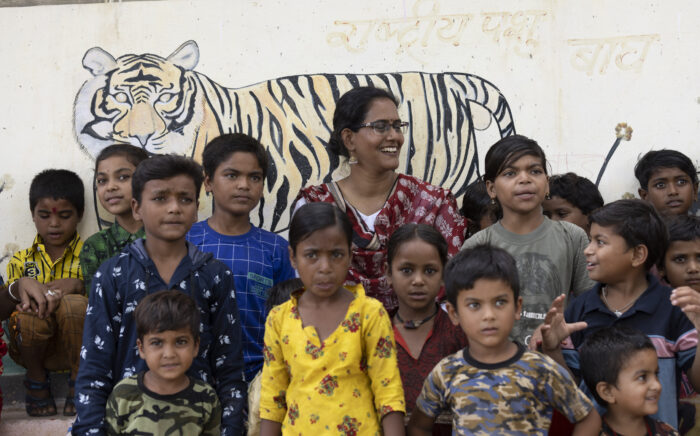
My work in wildlife and conservation has taught me one thing very clearly. Forests and their wild species cannot be protected unless the communities thatwho depend on them are part of the journey. This belief has shaped the identity of Last Wilderness Foundation since the beginning.
For more than a decade, we have been working in Madhya Pradesh with the Forest Department, focusing largely on human-wildlife conflict mitigation and on building long-term relationships with forest-dependent communities such as the Pardhis and the Baigas. Much of our work involves reducing their dependence on forests by strengthening traditional skills, introducing new livelihood options, and helping children access quality education so they can grow up with better choices and less economic vulnerability.
While I do not possess formal academic credentials in social science or anthropology, my early experiences travellingtraveling through forests provided valuable insights into the communities living within these regions. Over the past 12 years with Last Wilderness Foundation, I have continued to deepen my understanding of their lives, challenges, strengths, and stories. This article aims to present, on behalf of our community partners, the perspectives and knowledge they have generously shared.
Who Are the Pardhis?
While we work with several forest-dependent groups, this piece focuses on the Pardhis of Panna, Satna (now Maihar) and Katni districts of Madhya Pradesh.
Whenever we approach local government systems, the first question we are asked is about population numbers. Unfortunately, there is no reliable census for these DNT communities. Based on the limited region we work in and very small sample numbers, extrapolations suggest that the Pardhis may be over five lakhs in number and the Moghiyas over one lakh. But these are rough estimates. There is no official database today that accurately counts them.
Numbers aside, the more pressing question is: What does the average Indian know about these communities? Most people react with surprise or preconceived ideas when I introduce myself and speak about our work. Public perception tends to come from brief online summaries, old references, or sensational media reports linking Pardhis to poaching and wildlife crime. These impressions rarely capture the full story.
The term ‘Pardhi’ comes from the Sanskrit pāpardhi, meaning hunting or the game to be hunted. Historically, they were hunter-gatherers with exceptional tracking abilities. Their sub-castes include Baheliya-Pardhi, Phase-Pardhi, Gav-Pardhi, Berad-Pardhi, Guy-Pardhi, Chita-Pardhi and others.
During British rule, the Pardhis and more than a hundred other tribes were declared “criminals by birth” under the Criminal Tribes Act of 1871. Except for the Gav-Pardhis, who had shifted to agriculture, every sub-caste was marked under this law. This branding triggered a long period of harassment and discrimination that continues even today.
In 1952, after independence, the community was “denotified,” but the social stigma remained. Their name still surfaces in relation to poaching or illegal hunting, even though the circumstances and the people involved vary widely. Historically, they were also sought after for their skills, especially as game trackers for Maharajas and colonial hunters. There are even references to “Cheetah Pardhis,” who were said to have trained cheetahs for hunts, though I have never met anyone today who identifies with that lineage.
After the Criminal Tribes Act was repealed, different states began preparing lists of denotified tribes, with some communities being categorised as Scheduled Castes, Scheduled Tribes, or Other Backward Classes. Despite this, the Pardhis continue to be perceived with suspicion. Many adolescents find their names entered into police records as “habitual offenders” under the Habitual Offenders Act of 1952. The weight of this inherited stigma has shaped their lives for generations.
How Our Journey with the Pardhis Began
My own journey with the community began in Panna, an emerald landscape known for diamonds, but even more precious for its rich forest and wildlife, when Shri R. Sreenivasa Murthy, the then Field Director of Panna, invited us to engage with the Pardhis during the Tiger Reintroduction programme.
Between 2004 and 2008, tiger poaching was rampant. By 2009, the Panna Tiger Reserve had lost its last tiger. Poaching was considered the main cause, and the Pardhis were at the helm of it, on the frontline, centre of the media as per the Special Investigation Team (SIT) report.
But iIf tiger reintroduction was to work, it was clear that conservation strategies needed to include the Pardhi community. The Forest Department brought multiple government departments and organisations together, including Last Wilderness Foundation, to work with the community on education and alternative livelihoods.
Under Sarva Shiksha Abhiyan, two residential bridge courses were started to prepare Pardhi children for formal schooling. Adults received training in crafts, guiding, and other income-generating skills. This dual approach became the foundation of community-based conservation work in the landscape.
Years of collaboration eventually showed results. Today, Panna Tiger Reserve hosts more than 100 tigers, making it the only successful big-cat reintroduction site of its kind in the world.
Understanding the Community Today
Our decade-long engagement has given us deeper insight into the Pardhis’ culture and worldview. Many trace their ancestry to Rajputs and take great pride in this heritage. Their identity is tied strongly to self-respect, which makes it difficult for many to take up jobs perceived as “menial” or subordinate. When systems try to offer them livelihood opportunities, this cultural pride can become a challenge.
Their attire is distinct. Women wear brightly patterned sarees and heavy silver ornaments, while men often dress in white dhoti-kurta with colourful turbans, silver bracelets, and thick moustaches. Their voices are deep and recognisable, and their eyes have a striking glassy quality.
Despite being labelled for generations as “criminal,” they are warm, loyal, and deeply family-oriented. At the same time, many carry emotional scars from prolonged social exclusion. Quick tempers, impulsive reactions, and aggressive behaviour are not uncommon, especially among the youth.
One of the most interesting aspects of their culture is their naming tradition. They choose names so unique that no one else should have them. Over the years, I have met individuals named Bisleri Pardhi, Bottle Pardhi, Jaya-Prada Pardhi, Big-Bazaar Pardhi and many others, with Sorry Pardhi being the most recent one! Each a reflection of their creativity and humour.
Their clan identities are strong. Some clans collaborate, others do not, and disputes can escalate quickly. Clan names like Sisodia, Jarola, Solanki, Panwar, Bhagikna, and Jhalavadiya indicate lineage and influence social interactions.
Many still follow a semi-nomadic lifestyle and migrate for work for nearly half the year. Their skills as salespeople are almost unmatched; they can sell anything from imitation jewellery to talismans like rudraksha or “nagmani.” Some still trade in forest products, though not always legally.
Their marginalisation is visible everywhere. Settlements, or deras, are typically on the outskirts of villages, often lacking basic services. Documentation is rare. Many children are born at home or inside a forest, one of the reasons being that the local ASHA workers still hesitate to enter the settlements. In most legal or local disputes, the community is the first to be suspected. Some young Pardhi students have been jailed for crimes committed by others, simply because of their surname. They continue to fight long legal battles for justice.
Because mainstream systems have not included them, they rely on their own internal governance. Caste panchayats handle disputes. Practices like child marriage and aata-saata (exchange marriage) continue. Health issues are widespread, from malnutrition to learning disabilities to mental health concerns. We’ve also witnessed many children with partial or complete blindness, all of them mostly hailing from the same clan.
How We Try to Support Their Journey Forward
At Last Wilderness Foundation, we see each challenge as a chance to build trust, create opportunity, and make systems more accessible for the community.
The Panna Pardhi Empowerment Initiative was launched to ensure that children have better access to learning. Over the years, more than 500 children have entered hostels and formal schools. Some are now graduates; others are pursuing post-graduate degrees or nursing courses. Several young men & women have become certified nature guides, with some even working at Panna Tiger Reserve.
Early childhood education centres have been set up in multiple settlements, run by former Pardhi students themselves. In Gandhigram, we helped merge a Pardhi-run centre with the local Anganwadi under the ‘Adopt the Anganwadi’ scheme which is an important step in reducing social segregation.
Today, adults too are embracing new livelihoods as guiding tourists on the “Walk with the Pardhi” trail, crafting souvenirs under our partner Wildpines brand, driving e-rickshaws, managing poultry units, and more.
We also work with government services to ensure basic rights reach the community. Recently, after years of hesitation, Anganwadi and ASHA workers have started visiting two Pardhi deras in Shahnagar, registering children and monitoring expectant mothers. These small shifts are significant when viewed against decades of exclusion.
Our empowerment programme also closely works with the local administrative office to facilitate their identity cards such as the Birth certificates, Aadhar cards, Samagra ID (only for MP), caste certificate etc.
The Road Ahead
The Pardhi community has shown incredible resilience. Their story is one of endurance, adaptability, courage, and cultural richness. Working with them has reminded us that conservation cannot succeed by isolating people. When communities feel included and supported, both people and wildlife benefit.
Their journey is ongoing, and so is ours. Their experiences continue to teach us that protecting forests begins with understanding and supporting those who have lived closest to them for generations.